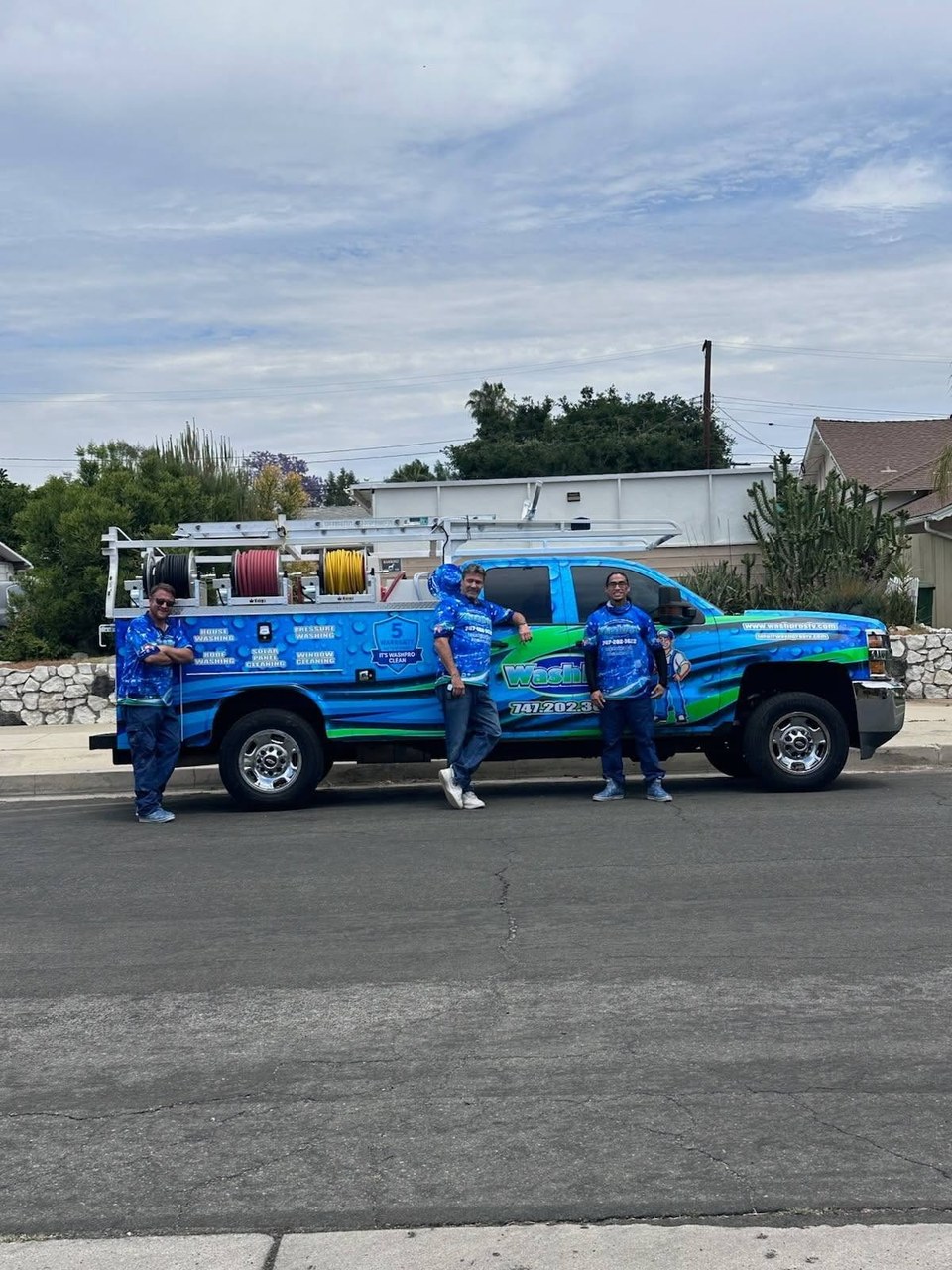
A straight answer from the crew that does this work across Los Angeles and Ventura County every week.
Thanks, we got it. A member of the WashPro crew will reach out shortly with your free estimate.
Or Call Us NowThose black streaks on your tile roof are colonies of Gloeocapsa magma, a cyanobacterium that feeds on the limestone in concrete and clay tiles. It spreads fastest on north-facing, shaded slopes and thrives in the marine-layer humidity common across Los Angeles and Ventura County. WashPro SFV removes it with a low-pressure soft wash that kills the organism at the root so it stops coming back.
The culprit has a long name but a simple weakness. Understanding what it is makes the treatment obvious.
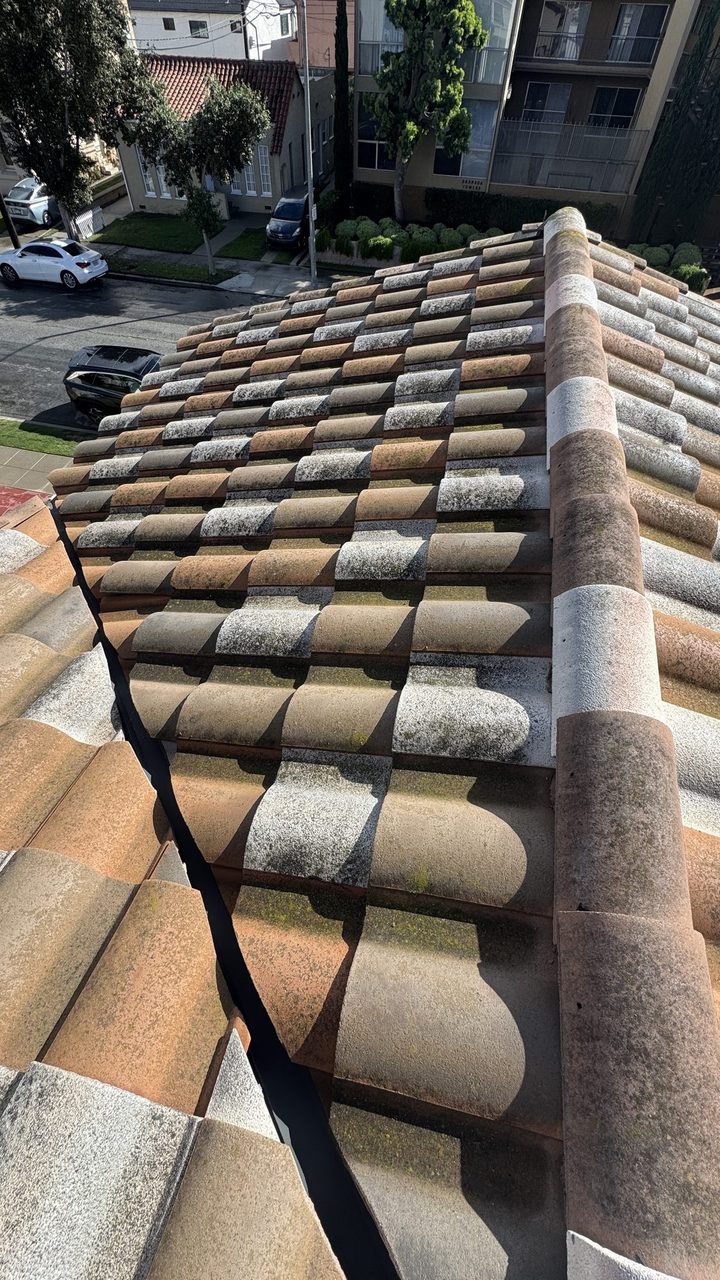
Gloeocapsa magma is a photosynthetic cyanobacterium, sometimes called blue-green algae, that has colonized rooftops across the country for decades. The organism forms a dark, pigmented outer sheath that protects its cells from UV radiation. That sheath is what you see as the black or dark gray streak running down the face of your tiles. The pigment is the algae's sunscreen, not dirt, and it does not scrub off with a garden hose.
In Southern California, the organism has a near-ideal habitat. Concrete and clay tiles are porous. They absorb calcium carbonate and other minerals that Gloeocapsa magma uses as a food source. The marine layer that rolls in off the Pacific most mornings provides the surface moisture the colony needs to metabolize and reproduce. On a typical tile roof in the San Fernando Valley or the coastal communities of Ventura County, a new colony can establish itself and become visible within a single wet season.
Algae colonies produce a dark protective pigment that appears as broad streaks running down tile faces.
The streaks do not appear randomly. They almost always start at the highest point of the roof, where spores settle, and run downward with the direction of water drainage. Overhanging tree limbs, satellite dishes, and chimney shadows create micro-zones of extra shade and retained moisture where colonies establish fastest. Once established, a colony releases spores that travel to adjacent tiles and, through wind and rain splash, to neighboring homes.
Homeowners across Pasadena, Glendale, and the Santa Monica Mountains notice the same pattern: the algae is dense on one slope and nearly absent on another. The reason is sun exposure. North-facing roof slopes in the Northern Hemisphere receive far less direct sunlight than south-facing slopes. Less sun means slower evaporation of morning dew and marine-layer condensation. A north-facing slope can stay damp for three to four hours longer than its south-facing counterpart on the same roof.
Gloeocapsa magma needs moisture to thrive. Give it a surface that stays wet longer, even slightly longer, and the colony establishes faster and grows denser. The table below shows the common factors that accelerate algae growth on tile roofs in the SFV, LA and Ventura region.
| Factor | Effect on Algae Growth | Common in SFV/LA/Ventura? |
|---|---|---|
| North-facing slope | Reduced UV exposure, slower drying | Every tile roof |
| Marine-layer humidity | Daily surface moisture even without rain | Coastal cities especially |
| Overhanging tree canopy | Shade plus leaf debris as extra nutrient source | Very common |
| Aging porous tile | More calcium carbonate available as food | Homes 10+ years old |
| Slow roof pitch | Water sits longer, promotes colonization | Flat-profile tiles |
| Copper or zinc absence | No natural algaecide from metal flashing | Most tile roofs lack these |
This is the question we hear most often from homeowners who had someone come out with a pressure washer and blast the roof clean, only to watch the black streaks reappear within a year or two. The answer is straightforward. High-pressure water removes the visible dark pigment, but it does not kill the organism. The algae cells living beneath the tile surface and in the pores of the tile material survive the blast. With the visual evidence gone, the colony rebuilds from the survivors already in place. You paid to clean the symptom, not the cause.
There is a second problem with high-pressure washing on tile roofs. Tile, particularly older concrete tile, is more fragile than it looks. High-pressure water strips the surface coating, opens the pores further, and can crack or dislodge individual tiles. A cracked tile creates a water intrusion point. The repair cost from a single cracked tile can exceed the cost of a proper soft wash treatment, and a roof with dozens of high-pressure-damaged tiles can develop leaks that are difficult to trace.
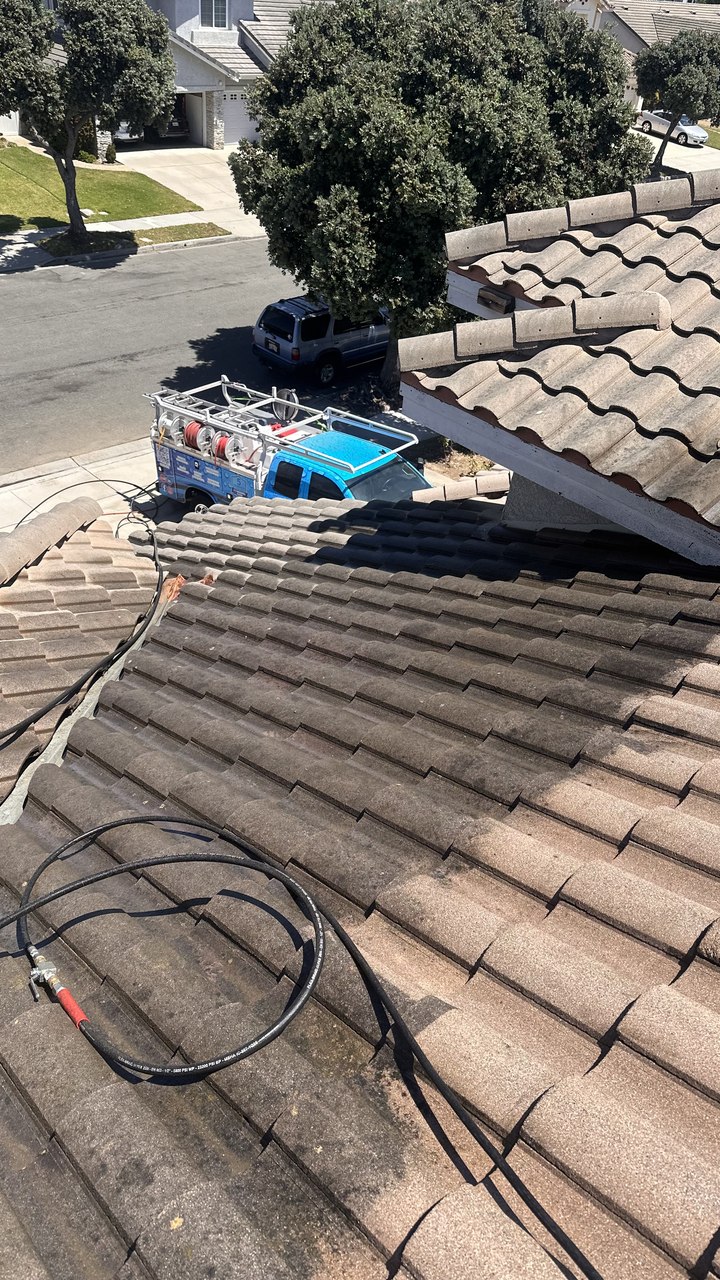
After a proper soft wash, the tile returns to its original color without surface damage or dislodged tiles.
Soft washing applies a diluted biocide solution at low pressure, typically well under 100 PSI, compared to the 1,500 to 3,000 PSI of a standard pressure washer. The solution penetrates the tile's porous surface and kills the algae at the cellular level, including the root-like structures called rhizoids that anchor the colony to the tile. Once the organism is dead, its pigmented sheath breaks down and washes away with normal rainfall. The treatment also neutralizes spores sitting on the surface, which delays recolonization significantly compared to a pressure wash alone.
For tile roofs across Los Angeles and Ventura County, a professionally applied soft wash typically keeps the roof clean for two to four years, depending on the level of nearby vegetation, the slope orientation, and proximity to the coast. A pressure-only cleaning often looks great for three to six months before the streaks return. The math is not complicated.
"After we soft wash a tile roof, we walk the ridge and check for missing or broken ridge caps. Those open gaps are where moisture gets under the tiles and where algae colonies establish first on the next cycle. Sealing them costs almost nothing compared to another full treatment two years early. A well-maintained tile roof can stay clean for three-plus years with one treatment in most of the neighborhoods we work."
WashPro SFV field crew, the San Fernando Valley
Beyond fixing structural gaps, there are a few practical steps that slow algae regrowth on tile roofs in Southern California.
None of these steps eliminate the need for periodic professional treatment. The marine-layer climate across the LA basin and Ventura County delivers a steady supply of airborne spores from neighboring properties. A tile roof without a zinc strip, without clean gutters, and without annual trimming will need more frequent cleaning than one where all three are in place. The goal is to extend the interval, not to avoid cleaning entirely.
WashPro SFV is a licensed, insured, family-run crew based in the San Fernando Valley serving homeowners and property managers throughout Los Angeles and Ventura County. We hold a reputation for consistent, careful work and we use soft washing exclusively on tile roofs. No high-pressure blasting, no cracked tiles, no short-lived results.
If you see black streaks on your tile roof, the fix is not complicated but it does need to be done correctly. See the full details on our tile roof cleaning service, or call 747-202-3622 to talk through your specific situation. We work We are available 24 hours a day, 7 days a week, with emergency service whenever you need us.
Yes, over time. Gloeocapsa magma produces acids as a byproduct of its metabolism. Those acids slowly etch into the calcium carbonate in concrete and clay tiles, increasing porosity and making the surface more hospitable to the next generation of algae. The damage is gradual, not sudden, but an older tile roof with a dense, long-standing algae colony will show measurably more surface degradation than a roof that has been maintained with periodic soft washing. Early treatment is cheaper than early tile replacement.
A diluted sodium hypochlorite solution can kill the algae if the concentration and dwell time are correct, but getting onto a tile roof safely with a sprayer and adequate coverage is a real challenge for most homeowners. Tile roofs are slippery, particularly when wet, and a fall from a single-story roofline is a serious injury. Beyond safety, the rinsing step matters. Inadequate rinsing leaves a residue that can harm surrounding landscaping and stain adjacent surfaces. Professional soft washing uses the correct dilution, proper surfactants, and a controlled rinse process. For most homeowners, the risk-to-benefit ratio of DIY roof treatment is poor.
For tile roofs in the SFV, LA and Ventura region, a properly applied soft wash typically maintains a clean appearance for two to four years. Roofs with heavy tree canopy, those in high-humidity coastal areas, and those with north-facing slopes that receive minimal direct sun will trend toward the shorter end of that range. Roofs in sunnier, more exposed positions with clean gutters and trimmed vegetation can stay clean for the longer end and beyond. The interval varies by property, which is why we assess each roof individually before recommending a treatment schedule.
Plant and pool protection is a standard part of our pre-treatment process. We wet down all surrounding vegetation before applying the soft wash solution, which dilutes any overspray that contacts plant leaves. Sensitive plants near the roofline get plastic sheeting if needed. Pool and spa surfaces are covered or flushed during the rinse step. When the job is done correctly, the landscaping and any water features are unaffected. We have cleaned tile roofs directly above established garden beds and decorative pools throughout Los Angeles and Ventura County without incident.
More from the WashPro blog on exterior cleaning costs and best practices in Southern California.
Call, text or send the form. We'll get right back to you with a free, no-pressure estimate, anywhere in Los Angeles or Ventura County.
Thanks, we got it. A member of the WashPro crew will reach out shortly with your free estimate.
Or Call Us Now