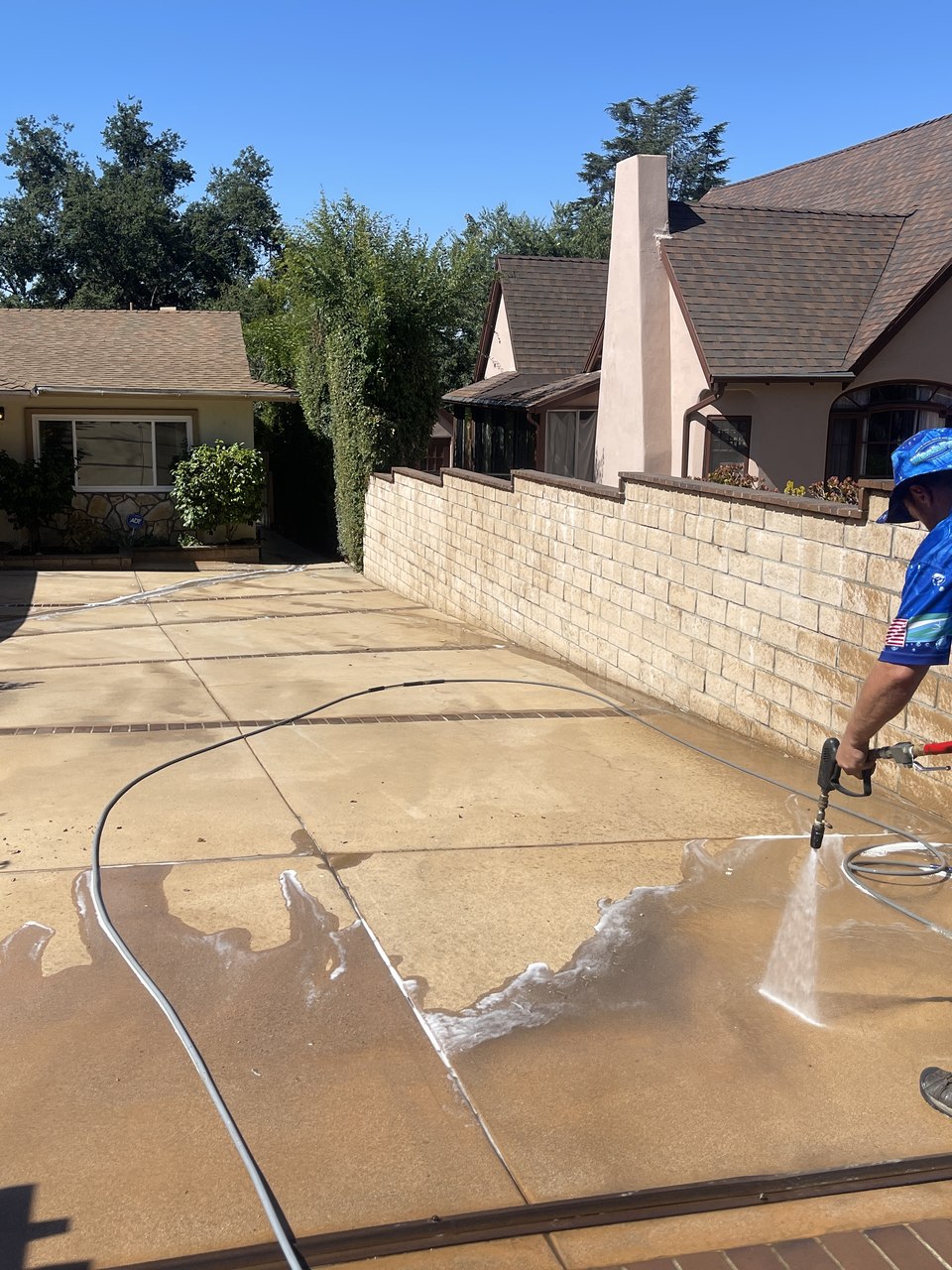
A straight answer from the crew that does this work across Los Angeles and Ventura County every week.
Thanks, we got it. A member of the WashPro crew will reach out shortly with your free estimate.
Or Call Us NowGraffiti removal from stucco, brick, and concrete requires the right chemical stripper matched to the surface porosity, followed by low-to-medium pressure rinsing. Fresh paint lifts in one pass. Paint older than 48 hours bonds deeper and may need two treatments. WashPro SFV handles graffiti removal across Los Angeles and Ventura County with licensed crews and surface-safe methods.
Graffiti on your building or commercial property in Los Angeles and Ventura County is not just an eyesore. It signals neglect to customers, invites repeat tagging, and in some LA County municipalities can trigger code violations if left unaddressed. The surface material under that spray paint determines everything: what chemistry you use, what pressure is safe, and how long the job takes. Get it wrong and you trade a graffiti problem for permanent surface damage.
This guide covers the three most common substrates in Southern California construction: stucco (the dominant exterior finish from the San Fernando Valley to Pasadena), fired brick, and poured or troweled concrete. Each behaves differently under paint and under pressure.
Spray paint does not stay on the surface. Within hours, solvent carriers in aerosol paint drive pigment molecules into open pores. Concrete is the most porous substrate; stucco is close behind. Brick varies by kiln temperature and glaze, but most LA-area brick is unglazed and absorbs quickly.
Paint hit within 24-48 hours of application can often be removed with a single application of an alkaline graffiti stripper and a 1,200-2,000 PSI rinse. Paint left for a week or longer requires dwell time with a stronger solvent-based product, multiple treatments, or both. Paint left for months may stain the substrate permanently even after the paint film is lifted, leaving a ghost image that only an anti-graffiti coating or paint can cover.
Property managers who set up rapid-response protocols, checking exposed surfaces every 24-48 hours, spend a fraction of what reactive accounts spend over the same period. That is the practical case for a maintenance agreement rather than one-time callouts.
| Surface | Porosity | Chemical Type | Safe Pressure Range | Common Pitfalls |
|---|---|---|---|---|
| Stucco (traditional) | High | Alkaline gel stripper | 800-1,500 PSI, wide fan | High pressure blows out aggregate; acid products etch surface |
| Stucco (elastomeric painted) | Low-medium | Solvent or citrus-based stripper | 600-1,200 PSI | Wrong solvent can bubble the elastomeric coat |
| Unglazed brick | Medium-high | Alkaline gel or solvent gel | 1,000-2,000 PSI, 15-25 degree tip | Wire brushing widens mortar joints; acid strips mortar |
| Poured concrete | Medium | Solvent-based stripper or hot-water extraction | 1,500-3,000 PSI | Over-stripping exposes aggregate and leaves texture variation |
| Exposed aggregate concrete | Very high | Citrus-based or gel stripper, never acid | 800-1,200 PSI | High pressure dislodges pebbles; acid discolors aggregate permanently |
Traditional three-coat stucco, which covers the majority of residential and commercial buildings in Southern California, is Portland cement based with sand aggregate and a finish coat that can be smooth, sand, or lace. The finish coat is typically 1/8 inch thick. High pressure or abrasive tools destroy it quickly. Wire brushing, grinding, and sanding all remove surface material along with the graffiti, leaving patches that never match the original texture.
The correct method is a low-VOC alkaline gel stripper applied with a brush or roller, allowed to dwell for 15-30 minutes, and rinsed with wide-fan pressure at or below 1,500 PSI. For elastomeric-coated stucco, test a small spot first: some elastomeric paints react with solvent-based products. If the test patch shows bubbling or blistering, switch to a water-based alkaline product.
Graffiti on brick looks like a brick problem. It is actually a mortar problem. The painted surface spans both units and joints, but mortar is softer than brick and dissolves faster under acid and pressure. Pressure-washing brick at concrete-appropriate settings (2,500 PSI or above) can erode mortar joints by 1/4 inch or more in a single pass, requiring expensive repointing.
Gel-based strippers are the right choice for brick because they stay where you put them, penetrate the paint film slowly, and lift it without requiring aggressive pressure to rinse. Work in 4-foot sections, apply gel, wait 20 minutes, and rinse at 1,200 PSI with a 25-degree tip held 12-18 inches from the surface. Multiple passes at low pressure beat one aggressive pass every time.
Poured concrete and concrete block tolerate higher pressure than stucco or brick, which leads many people to skip chemical pre-treatment entirely. Pressure alone rarely removes graffiti fully. It strips the top layer of paint but drives pigment further into open pores, leaving a cleaner version of the same ghost image.
Pre-treating with a solvent-based stripper before rinsing is the reliable method. Hot water (160-200 degrees F) accelerates chemical action and reduces dwell time on fresh paint. For older paint, allow 30 minutes of dwell before rinsing at 2,000-3,000 PSI.
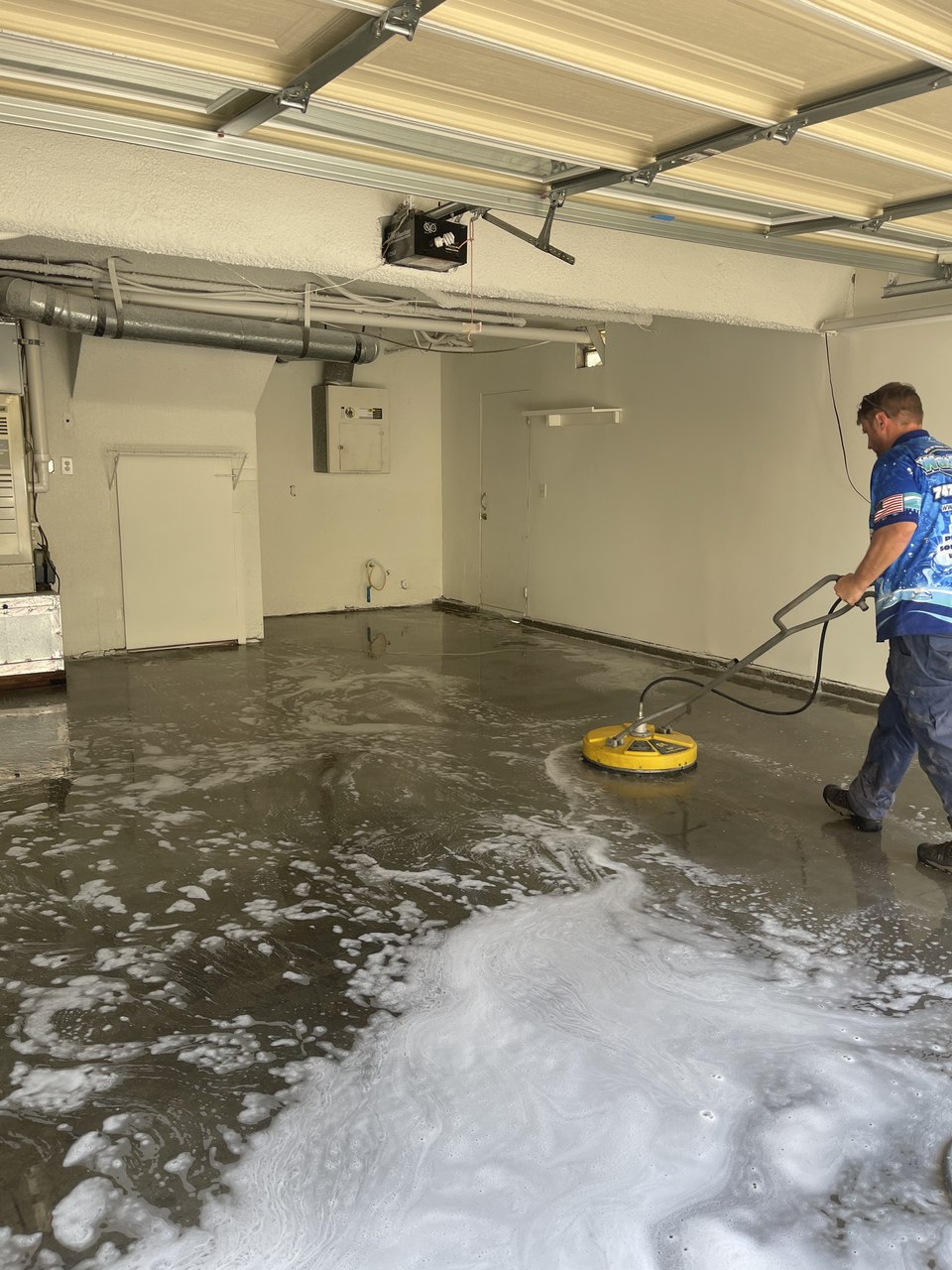
The most common mistake is reaching for physical abrasion first: wire brushing, angle grinding, or sanding. These methods do remove the paint film but they also remove surface material, opening larger pores that future paint, dirt, and moisture penetrate more easily. On stucco, abrasion leaves a rough, blotchy patch that absorbs paint differently than surrounding areas. No amount of pressure washing corrects it afterward. The building ends up needing a full repaint of the affected elevation.
The second most common mistake is using muriatic acid on masonry without understanding what it does. Acid etches concrete and dissolves mortar. It can lighten some stains, but it leaves the surface chemically altered: more porous, more prone to future staining, and visibly lighter than untreated areas. On colored or pigmented masonry, acid causes permanent discoloration. It is not a graffiti removal product.
Third: using a 0-degree or 15-degree tip on a surface that needs a 25-degree or wider fan. The narrow tip concentrates water impact into a line. On stucco it blows out aggregate and creates linear gouges. On concrete, it leaves striping patterns. On brick it pits the face of the unit. The correct tip for most graffiti work is a 25-degree or 40-degree fan, adjusted for the specific surface condition.
"From the crew: when we arrive to a graffiti job, the first thing we check is how old the paint is and what the substrate looks like underneath. A week-old tag on raw concrete needs a completely different approach from a fresh hit on elastomeric stucco. Getting the chemistry wrong costs more than calling us in the first place."
After the graffiti is removed, the surface is clean and, in many cases, more porous than before. That makes it an easier target. Anti-graffiti coatings applied to the clean substrate significantly reduce the bond that spray paint forms with the surface, making future removal faster and less expensive.
Two categories exist. Sacrificial coatings are wax-based products that create a non-stick layer. When graffiti hits, you wash off the coating along with the paint, then reapply. They are inexpensive and effective but require reapplication after every cleaning. Permanent (non-sacrificial) coatings are penetrating silane- or siloxane-based sealers that become part of the substrate. Graffiti bonds only to the sealer, not the pores beneath. These hold up through multiple graffiti cycles without reapplication, making them cost-effective on high-target surfaces like freeway-adjacent walls, parking structures, and commercial storefronts.
Matte finishes are available for both types, so the treatment is visually invisible on most masonry. Glossy variants are common on smooth concrete but look out of place on sand-finish stucco.
Most property owners can handle a small, fresh tag on smooth concrete with a consumer-grade degreaser and a garden hose. The job becomes professional territory when any of these conditions apply:
Southern California municipalities including Los Angeles, the San Fernando Valley, Torrance, and many Ventura County cities have ordinances requiring property owners to remove graffiti within a set timeframe, typically 10-30 days of discovery. Repeated violations can result in the city removing the graffiti and billing the owner at above-market rates. A fast professional response keeps you compliant and prevents secondary tagging, which commonly follows visible graffiti within days.
Our commercial graffiti removal service covers property types across Los Angeles and Ventura County: retail storefronts, office buildings, industrial facilities, parking structures, and residential community walls. We carry the correct chemical inventory for stucco, brick, concrete, and CMU block. We also offer maintenance agreements for property managers who want a rapid-response protocol rather than reactive one-off calls.
For an exact quote on your property, send us the details here or call 747-202-3622.
Rarely, and often at the cost of surface damage. Pressure alone on stucco pushes pigment deeper into the pore structure and risks blowing out the finish aggregate. The correct process pairs a dwell-time chemical stripper with low-to-medium pressure rinsing at a wide fan angle. Chemical pre-treatment does most of the work; pressure does the rinse, not the removal.
Fresh paint on concrete, treated within 48-72 hours, typically removes cleanly with no residual shadow. Older paint, especially dark colors on light concrete, can leave a ghost image even after the paint film is fully lifted. This happens because pigment molecules have bonded to calcium silicate in the pore walls. In those cases, a penetrating sealer applied after cleaning minimizes the visual effect, and an anti-graffiti coating prevents the same issue on future tags.
Alkaline gel strippers and solvent-based gel products designed for masonry are the standard choices. Gel formulations are preferred over liquid because they stay on vertical surfaces, extend dwell time, and do not run into mortar joints in high concentration. Acid-based products should never be used on brick: they dissolve mortar, permanently etch the brick face, and cause widespread color change. The rinse pressure for brick should stay between 1,000-2,000 PSI with a 25-degree tip.
Cost varies based on surface type, paint age, tagged area size, and access requirements. Stucco and textured masonry take longer than smooth concrete. Older paint requires more chemical product and dwell time. As a broad honest range, small-to-medium single-surface removals in the LA & Ventura area typically run from a few hundred dollars up into the thousands for larger multi-surface or multi-elevation jobs. The only accurate number is an on-site or photo-based quote. Request yours here at no charge.
More practical answers from the WashPro crew on exterior cleaning across Southern California.
Call, text or send the form. We'll get right back to you with a free, no-pressure estimate, anywhere in Los Angeles or Ventura County.
Thanks, we got it. A member of the WashPro crew will reach out shortly with your free estimate.
Or Call Us Now