Cleaning Frequency Guide
How Often Should You Clean Solar Panels in SoCal?
Location, surroundings, and seasonal events drive the answer more than any single rule.
| Property Type |
Recommended Frequency |
Key Reason |
| Standard suburban home, coastal LA or Ventura County |
2 times per year |
Marine layer deposits, airborne dust, occasional pollen |
| Home within a mile of a major freeway |
3 to 4 times per year |
Diesel particulate and tire rubber accumulate quickly on flat glass |
| Property near agricultural land (parts of Ventura County, San Gabriel Valley) |
3 to 4 times per year |
Pesticide drift and dust from tilled soil coat panels between irrigations |
| Any property after a wildfire event |
Immediate service recommended |
Ash is acidic and abrasive. Delay compounds the damage to the glass coating |
| Commercial or multi-family with large arrays |
Quarterly |
Output loss on large systems has a measurable dollar impact per quarter |
Why Rain Does Not Clean Solar Panels
This is the most common misconception. A homeowner assumes winter rain will handle maintenance and skips professional cleaning. The problem is that rainwater carries dissolved minerals and airborne particles. As the water evaporates, those minerals stay behind in a thin, hard film. That film is not visible from the ground but it is present on every panel that has seen a few rain events without a cleaning in between.
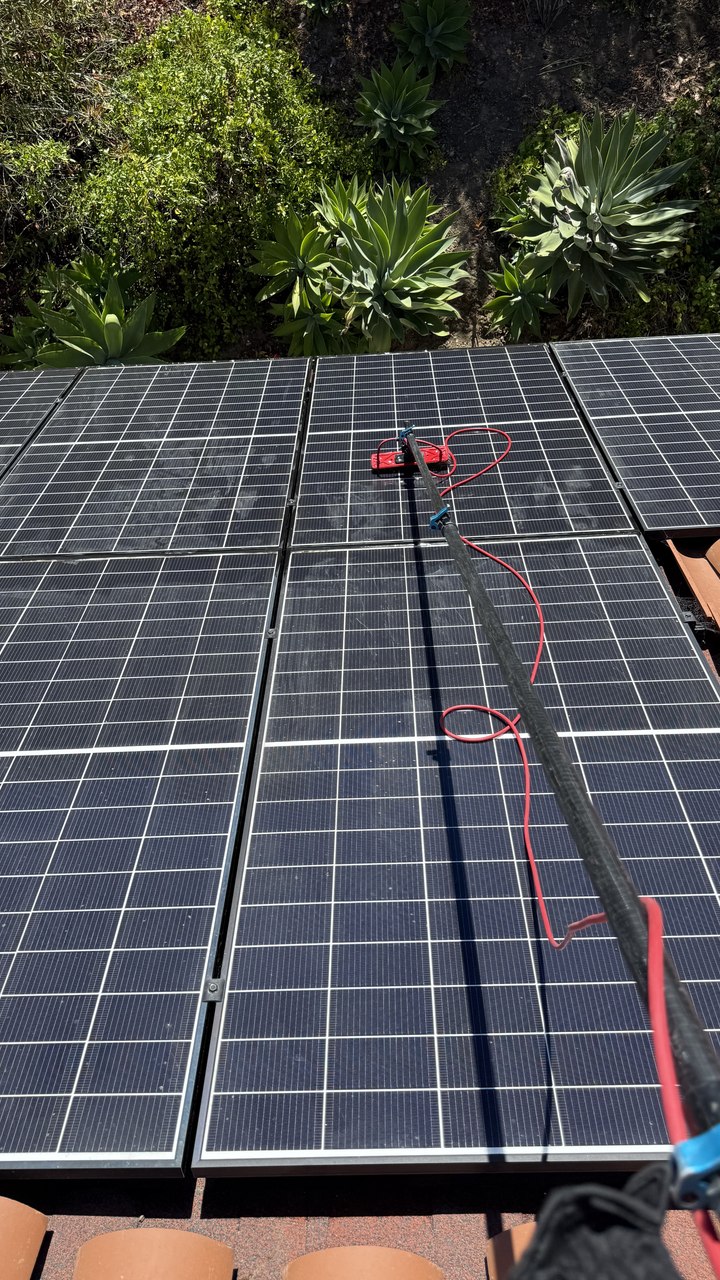
Tap water has the same problem, which is why a garden hose rinse does not solve anything. The only method that leaves glass residue-free is purified, deionized water. DI water has had its mineral content removed through a filtration process. When it dries on glass, there is nothing left behind. Every visit WashPro SFV makes to a panel array uses DI-water fed through soft brushes. Nothing abrasive, no chemicals, no streaks.
The LA & Ventura Specifics: What Makes This Region Different
The Marine Layer and Coastal Properties
Coastal properties from Malibu down through Calabasas and across to Thousand Oaks sit under a marine layer for much of the spring and summer. That marine layer is not just fog. It carries dissolved sea salt and micro-particles of organic material. When it condenses on a cool panel surface overnight and then evaporates in the morning sun, it leaves a thin mineral film. Over weeks, those films stack. By midsummer, a coastal panel that has not been cleaned since January is working through a meaningful layer of accumulated salt haze.
Freeway Corridors and Air Quality Zones
Homes within a mile or two of the 405, the 110, the 91, or the 5 experience elevated particulate deposition. Diesel exhaust and tire rubber produce fine particles that travel on wind currents and settle on horizontal and near-horizontal surfaces, which includes solar panels. In these zones, the 2-times-per-year baseline climbs. Quarterly cleaning is worth considering for properties in heavy freeway corridors.
Santa Ana Wind Events
Santa Ana winds push dry air from the interior toward the coast, picking up dust, soil, and dry vegetation debris along the way. A single multi-day Santa Ana event can deposit more particulates on a panel surface than months of normal ambient conditions. After a significant wind event, a quick inspection of the panels is worth doing. If the glass is visibly dusty, that cleaning should move up rather than wait for the next scheduled visit.
Post-Wildfire Ash
Ash from wildfires is a distinct hazard. It is not just dirt. Ash contains carbon particulates and can carry acidic compounds from burned vegetation and structure materials. Left on solar glass for weeks, it can affect the anti-reflective coating some manufacturers apply to their panels. After any major wildfire event in the LA or Ventura County footprint, properties downwind should schedule an immediate panel rinse and cleaning rather than wait. This is not alarmist, it is straightforward maintenance protocol given what ash contains.