Get A Free Quote It takes only 5 seconds
Open 24/7 Serving Los Angeles & Ventura County
Emergency service available 747‑202‑3622
Solar

Does Cleaning Solar Panels Actually Increase Output?

A straight answer from the crew that does this work across Los Angeles and Ventura County every week.

Licensed & InsuredSatisfaction GuaranteedFamily Owned & Operated
Free Estimate · No Obligation

Get a Fast Quote

Tell us where & what, we'll get right back to you.

Please enter your name
Enter a valid email
Enter a valid phone number

It takes 5 seconds

Request Sent!

Thanks, we got it. A member of the WashPro crew will reach out shortly with your free estimate.

Or Call Us Now
The Short Answer

Yes. In Southern California's dry climate, soiling losses on solar panels commonly run 15 to 25 percent compared to a freshly cleaned baseline. On a typical 8 kW residential system that means hundreds of kilowatt-hours left on the table each year. WashPro SFV restores output with a pure-water, no-pressure process that is safe for panels and warranties.

Why Dirty Panels Lose Output in LA and Ventura County

Southern California's weather pattern is the core problem. Rain is rare, especially from April through October. Dry Santa Ana winds carry fine dust and pollen across the basin for weeks at a stretch. Marine layer moisture settles overnight near the coast and then dries by mid-morning, leaving a thin salt residue behind. Without regular rainfall to rinse panels clean, that grime accumulates layer by layer across the glass surface.

Photovoltaic panels generate electricity when sunlight reaches the silicon cells beneath the glass. Soiling blocks and scatters that sunlight before it ever reaches the cells. The dirtier the glass, the steeper the output penalty. Uniform dust diffuses incoming light evenly across the panel; concentrated soiling from bird droppings is worse because it creates localized shading that can trigger hot-spot damage over time.

The result in practical terms: a system that your installer quoted at full rated output can be generating noticeably less power, and your inverter app shows it if you know what to look for.

What Do the Output Numbers Actually Look Like?

Industry studies on soiling losses in arid and semi-arid climates, including work from universities in California and the Southwest, consistently point to soiling losses in the 15 to 25 percent range for panels that go several months without cleaning. Some findings show losses at the lower end of that band after just 60 to 90 days without rain; panels that go a full dry season with heavy bird traffic can reach the upper end or beyond.

Here is how the math works on a common residential installation:

System Size Annual Output (Clean) At 15% Soiling Loss At 25% Soiling Loss
6 kW ~9,000 kWh/yr ~7,650 kWh/yr ~6,750 kWh/yr
8 kW ~12,000 kWh/yr ~10,200 kWh/yr ~9,000 kWh/yr
10 kW ~15,000 kWh/yr ~12,750 kWh/yr ~11,250 kWh/yr

Those are broad illustrative ranges, not a guarantee for your specific system, roof angle, or local conditions. But the direction is clear: soiling is not a minor rounding error. It is a real performance gap that a cleaning visit can close.

The only way to know the exact impact on your system is to check your inverter monitoring app. Most modern inverters, including systems from SolarEdge, Enphase, and SMA, log daily and hourly production. Note the per-panel or string output figures before a cleaning, then check again several days after. A meaningful production jump confirms soiling was the limiting factor.
Bird Droppings: The Worst Soiling Problem on LA Rooftops

Uniform dust is manageable. Bird droppings are a different problem entirely.

Los Angeles County has a high concentration of gulls, pigeons, and starlings that roost on residential and commercial rooftops. Droppings are acidic and bond chemically to panel glass over time. Unlike loose dust, dried droppings cannot be rinsed away with plain water. They require the right dwell-time and gentle agitation to release without scratching the anti-reflective coating on the panel face.

The other issue is hot spots. A dropping that covers even a small portion of one cell forces the entire cell, and sometimes the whole string, to reduce output to match the shaded section. Left in place over months, localized hot spots can cause micro-cracks or delamination in the cells beneath, which is permanent performance degradation.

The practical takeaway: if you see visible droppings on your panels, that is not a cosmetic issue. It is a production and longevity issue that justifies a cleaning regardless of what the calendar says.

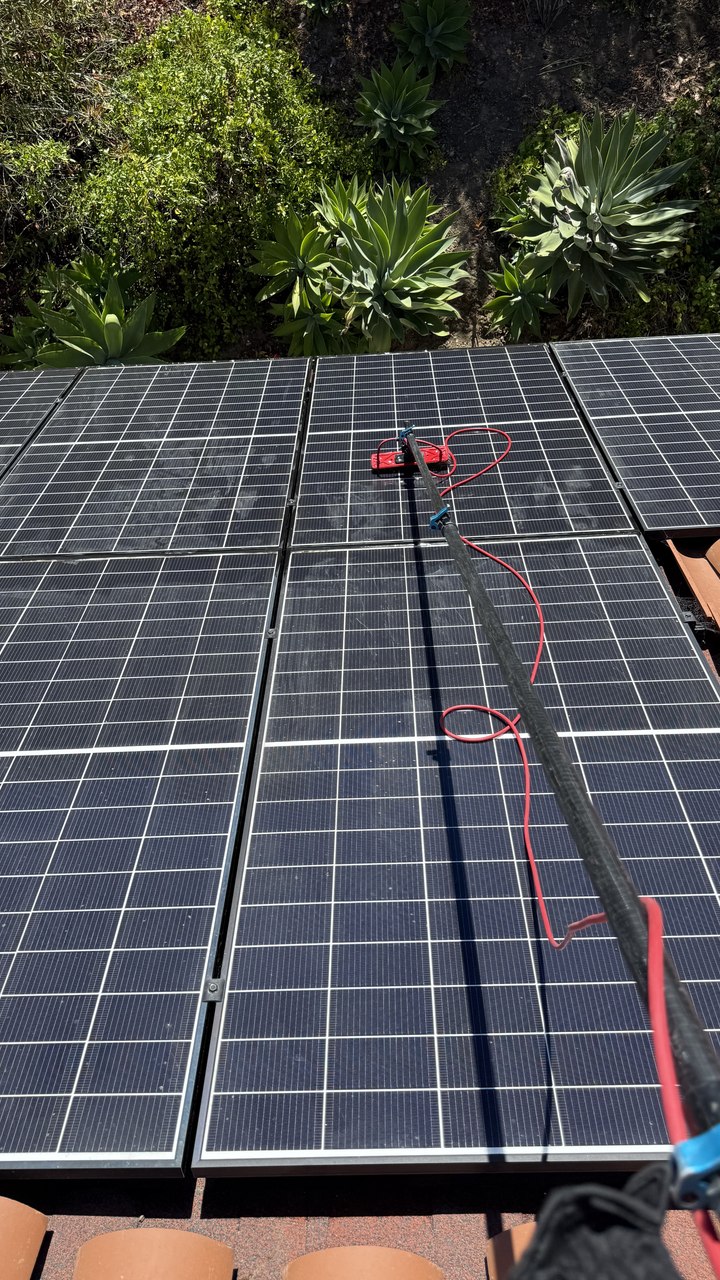
Technician cleaning rooftop solar panels on a residential home

How to Check Your Inverter App Before and After

Your inverter app is the most direct way to confirm whether a cleaning made a measurable difference. Follow these steps:

  • Before the cleaning: Open the app on a clear, sunny day and note the system's real-time power output around solar noon. Write down the date, time, and the reading.
  • After the cleaning: On the next comparable clear day, check the same reading at the same time of day. Compare it to your pre-cleaning note. Normalize for any difference in weather: a slightly overcast day will produce less regardless of panel cleanliness.
  • Check historical data: Most apps display a month-by-month or year-over-year comparison. A pattern of declining production through the dry season, followed by a recovery after cleaning, makes the soiling effect visible over time.
  • Flag anomalies: If one string or one panel is consistently underperforming others, that panel likely has concentrated soiling or a dropping that did not fully clear. Let your cleaning crew know before the next visit.

The inverter app data is also useful when scheduling future cleanings. If you can see that your production dips noticeably around August each year after a summer without rain, you now have a baseline for when to schedule the next visit.

From the crew: We recommend customers screenshot their inverter app the morning before we arrive and again three or four days after, when any trace of the cleaning water has fully evaporated. That comparison is the clearest before-and-after you will get. On panels that were significantly soiled, the difference is usually obvious at a glance.

How Professional Solar Panel Cleaning Works

The method matters as much as the cleaning itself. Panels cleaned with hard tap water leave mineral deposits behind as the water evaporates. Cleaning with abrasive tools or high pressure risks scratching the glass or stripping the anti-reflective coating. Neither outcome is acceptable on equipment that costs thousands of dollars and is expected to last 25 years.

WashPro SFV uses a deionized, pure-water system for solar panel work. Deionized water has had minerals removed, so it dries completely clear with no spots or scale. The delivery system uses soft brush heads and low, controlled flow rates. No harsh chemicals, no pressure washing. The result is a panel face that is optically clean and chemically neutral.

For bird droppings and stubborn residue that plain water will not release, the crew uses a small amount of a manufacturer-approved panel-safe cleaning agent before the pure-water rinse. The finish is the same: mineral-free, residue-free glass.

Roof safety is a separate consideration. Working on a wet, pitched roof without proper footing creates fall risk. Our crew is trained for rooftop work and equipped accordingly. That is part of what you are paying for when you hire professionals rather than turning your garden hose on the array yourself.

Ready to find out how much output you have been leaving behind? See full details on our solar panel cleaning service, then request a free quote for your property.

Common Questions

Frequently Asked Questions

Straight answers to what homeowners across Los Angeles and Ventura County ask most.

In Southern California's dry climate, industry research on soiling losses commonly shows panels operating 15 to 25 percent below their clean baseline after several months without rain. The exact recovery depends on how much soiling has accumulated, your roof pitch, local wind patterns, and whether bird droppings are involved. Check your inverter app a few days after cleaning to see the actual delta on your system.
Most LA and Ventura County homeowners benefit from one to two professional cleanings per year. Properties with significant bird activity, coastal salt exposure, or properties near construction or agricultural land often need more frequent visits. The best approach is to check your inverter app production data: if output has dropped noticeably from your seasonal baseline, it is time to clean.
Yes, over time. Droppings are acidic and can etch glass with extended contact. More immediately, a dropping that shades even a portion of a single cell can trigger a hot spot: the shaded cell resists current flow, converts excess energy to heat, and over time can cause micro-cracks or delamination. Removing droppings promptly is both a performance and a longevity measure.
It depends on how you do it. A soft rinse from a garden hose on a single-story roof can work for light dust between professional visits. Problems arise when homeowners use pressure washers, hard tap water, or abrasive tools, any of which can scratch glass, force water into junction boxes, or leave mineral deposits. Hard tap water also leaves scale that scatters light. For proper deep cleaning, deionized water and professional technique produce reliably better results.
Keep Reading

Related Articles

More from the WashPro blog on exterior cleaning costs and results.

Free Estimate

Let's make it
shine.

Call, text or send the form. We'll get right back to you with a free, no-pressure estimate, anywhere in Los Angeles or Ventura County.

Call or Text
Hours
Open 24/7
Emergency service available
Payments Accepted
CashCardDirect DepositCheck

Request Your Free Estimate

Fill this out and we'll be in touch fast.

Please enter your name
Enter a valid phone number
Please choose a service

No spam, no obligation. We'll only use your info to give you a quote.

Request Sent!

Thanks, we got it. A member of the WashPro crew will reach out shortly with your free estimate.

Or Call Us Now

Ready to restore the
look of your property?

Get A Fast Quote
Call Now Free Estimate